Collisional strategy
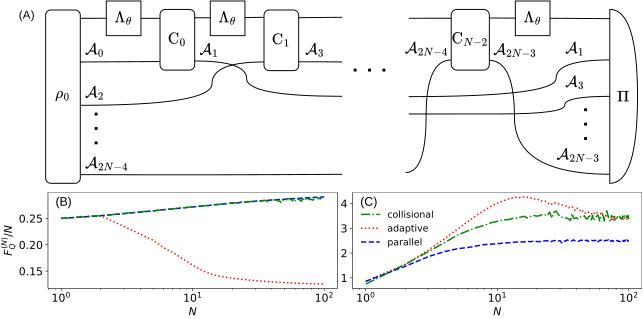
Fig. 14 (A) Diagram of a collisional strategy with multiple parametrized channels \(\Lambda_\theta\) and ancillas \(\mathcal{A}_i\). Values of QFI normalized by the number of channel uses, \(N\), for: (B) dephasing (\(p=0.75\)), (C) amplitude damping (\(p=0.75\)) and different strategies: adaptive (\(d_\mathcal{A}=2\)) – blue dashed line, parallel (\(d_\mathcal{A}=2,\; r_\mathrm{MPS}=\sqrt{r_\mathfrak{L}}=2\)) – red dotted line, collisional (\(d_\mathcal{A}=2,\; r_\mathrm{MPS}=\sqrt{r_\mathfrak{L}}=2\)) – green dash-dotted line. Fluctuations for larger \(N\) are due to numerical instabilities.
We will describe the creation of a custom strategy using the example of a collisional strategy depicted in Fig. 14 (A). Physically, we can imagine this scheme to represent a situation where multiple particles, potentially entangled with each other initially, approach the sensing system one by one. They interact locally with the system via control operations \(\mathrm{C}_i\), carrying away information about the parameter while at the same time causing some back-action on the sensing system itself.
This strategy may be viewed as a hybrid of the parallel and the adaptive strategies where each control operation \(\mathrm{C}_i\) has its own ancilla which is measured immediately after the action of \(\mathrm{C}_i\). Notice that if all \(\mathrm{C}_i\) were set to SWAP gates one would regain the parallel strategy. On the other hand, this strategy does not allow control operations to communicate with each other like in the most general adaptive strategy. Therefore the QFI for this strategy must be at least as good as for the parallel strategy but in general will be worse than for the adaptive strategy with an ancilla dimension \(d_\mathcal{A}^{N-1}\), where \(d_\mathcal{A}\) is the dimension of a single ancillary system in the collisional strategy.
We can now create a tensor network representing the collisional strategy. In the
following we will use functions from
creators/single and
creators/structures.
These functions greatly simplify the process by creating
entire structures (for example the density matrix of an MPS) and they make the
code more readable. Let us start by defining the necessary spaces:
from qmetro import *

# Number of parametrized channels:
N = 10
d_a = 2  # Ancilla dimension.

sd = SpaceDict()

# arrange_spaces will create a series of spaces:
# ('INP', 0), ..., ('INP', N-1)
# with specified dimension and it will return a list of their names:
# > input spaces of parametrized channels:
inp = sd.arrange_spaces(N, 2, 'INP')
# > output spaces of parametrized channels:
out = sd.arrange_spaces(N, 2, 'OUT')
# > ancillas:
anc = sd.arrange_spaces(2*N-2, 2, 'ANC')
The input state can be created using
input_state_var
or
mps_var_tnet:
# First input space and ancillas with even indices:
spaces = [inp[0]] + anc[::2]
rho = input_state_var(spaces, name='RHO0', sdict=sd)

# In case we want to optimize over MPSs:
r_mps = 2  # MPS bond dimension.
rho0 = input_state_var(spaces, 'RHO0', sd, mps_bond_dim=r_mps)
# or equivalently:
rho0, rho0_names, rho0_bonds = mps_var_tnet(spaces, 'RHO0', sd, r_mps)
Both of these functions create the same MPS but
mps_var_tnet returns
additionally names of its components and bond spaces which might become useful
later for accessing the optimization results.
Tensors of parameter-encoding channels can be created using the
tensor
method from the
ParamChannel
class:
# Parameter-encoding channel:
channel = par_dephasing(0.75)

# This will be the tensor network of our
# strategy:
tnet = rho0

# Adding channels to tnet:
for i in range(N):
    inp_i = inp[i]  # i-th input space.
    out_i = out[i]  # i-th output space.
    pt = channel.tensor([inp_i], [out_i], sdict=sd, name=f'CHANNEL{i}')
    tnet = tnet * pt
We want the control operations to be CPTP maps, hence we will use
cptp_var creator:
for i in range(N-1):
    c_inp = [out[i], anc[2*i]] # i-th control input spaces
    c_out = [inp[i+1], anc[2*i+1]] # i-th control output spaces
    # Variable control operation:
    vt = cptp_var(c_inp, c_out, sdict=sd, name=f'CONTROL{i}')
    tnet = tnet * vt
Similarly to the input state, the measurement can be created in one of two ways:
# Ancillas with odd indices and last output space:
spaces = anc[1::2] + [out[-1]]
Pi = measure_var(spaces, name='Pi', sdict=sd)

# In case we want to optimize over pre-SLD which is MPO:
r_L = r_mps * r_mps  # pre-SLD bond dim.
Pi = measure_var(spaces, 'Pi', sd, bond_dim=r_L)
# or equivalently:
Pi, Pi_names, Pi_bonds = mpo_measure_var_tnet(spaces, 'Pi', sd, r_L)

tnet = tnet * Pi
In summary, the code is:
from qmetro import *

ch = par_dephasing(0.75)  # Channel.
N = 10  # Number of channels.
d_a = 2  # Ancilla dimension.
r_mps = 2  # MPS bond dimension.
r_L = r_mps**2  # pre-SLD bond dimension.

sd = SpaceDict()
inp = sd.arrange_spaces(N, 2, 'INP')
out = sd.arrange_spaces(N, 2, 'OUT')
anc = sd.arrange_spaces(2*N-2, 2, 'ANC')

rho0_spaces = [inp[0]] + anc[::2]
rho0, rho0_names, rho0_bonds = mps_var_tnet(rho0_spaces, 'RHO0', sd, r_mps)

tnet = rho0
for i in range(N):
    pt = ch.tensor([inp[i]], [out[i]], sdict=sd, name=f'CHANNEL{i}')
    tnet = tnet * pt

for i in range(N-1):
    vt = cptp_var(
        [out[i], anc[2*i]], [inp[i+1], anc[2*i+1]],
        sdict=sd, name=f'CONTROL{i}'
    )
    tnet = tnet * vt

spaces = anc[1::2] + [out[-1]]
Pi, Pi_names, Pi_bonds = mpo_measure_var_tnet(spaces, 'Pi', sd, r_L)

tnet = tnet * Pi
To optimize our strategy, we need to simply put it into
iss_opt:
qfi, qfis, tnet_opt, status = iss_opt(tnet)
where qfi is the optimized QFI, qfis is a list of pre-QFI values per
iteration, status tells whether the optimization converged successfully and
tnet_opt is a copy of tnet where each
VarTensor
is replaced with a
ConstTensor
storing the result of the strategy optimization. To access those
values we need to use the names of the required tensor and its spaces:
i = 2

# Accessing the CJ matrix of the i-th control operation:
name = f'CONTROL{i}'
# i-th control operation tensor:
C_i = tnet_opt.tensors[name]

spaces = [inp[i+1], anc[2*i+1], out[i], anc[2*i]]
# CJ matrix with spaces in the order given by the argument:
choi = C_i.choi(spaces)

# Accessing the i-th element of the MPS density matrix:
name = rho0_names[i]
# i-th element of the state's density MPO:
rho0_i = tnet_opt.tensors[name]

spaces = [rho0_bonds[i-1], rho0_spaces[i], rho0_bonds[i]]
# MPS element with indices in the order given by the argument:
psi_i = rho0_i.to_mps(spaces)
Fig. 14 (B) and (C) show the optimized values of the QFI for the collisional strategy together with the parallel and the adaptive ones for comparison. It turns out that in the case of the dephasing noise (B), additional control operations do not help and the results are the same as for the parallel strategy. On the other hand, for the amplitude damping noise (C) the collisional strategy is significantly better than the parallel one and appears to be able to beat the adaptive strategy for \(N>100\), under the given limited ancillary dimensions. This proves that in this case, the optimal strategy found is qualitatively different from both the parallel and the adaptive ones.