Advanced package usage—optimization of strategies with arbitrary structures
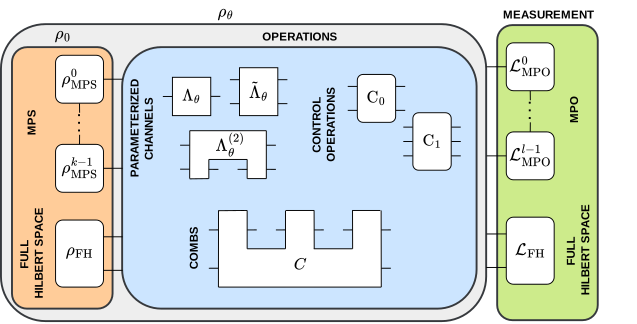
Fig. 12 Diagram of a strategy with arbitrary structure that can be optimized using
iss_opt. The input state,
\(\rho_0\), might
consist of MPSs and/or states on a full Hilbert space. The input state goes
through an arbitrary arrangement of parametrized channels, control
operations and combs. The requirement is that each operation’s output can be
connected only to the input of a different operation such that there are no
causal cycles. Finally, the state obtained after application of each
operation, \(\rho_\theta\), is measured. The measurement is specified by
the form of the pre-SLD matrix \(\mathfrak{L}\) which can be an MPO and/or
a matrix on a full Hilbert space. States, control operations, and combs can be
marked as variable or constant, the pre-SLD must be variable and the
parametrized channels must be constant.
In addition to the functions presented in Basic package usage—optimization of standard strategies, the QMetro++ allows
the user to define their own strategy and then optimize it using the ISS
algorithm. Strategies are defined via a straightforward-to-use symbolic
programming framework. The user creates a tensor network representing their
strategy where some of the nodes are marked as constants and others are marked
as variables to be optimized over—let us call the set of variables
\(\mathcal{V}\). This strategy is then plugged into the function
iss_opt which, based on
the provided data, constructs the pre-QFI:
where \(\rho_\theta\) and \(\mathfrak{L}\) are defined as in Fig. 12 and \(\dot{\rho}_\theta\) is created from \(\rho_\theta\) using the Leibniz (chain) rule. Then the function optimizes the above pre-QFI over each variable node one by one in a typical ISS manner.
In QMetro++ tensors we explain the classes of QMetro++ tensors which are the building blocks of strategies. Then in Collisional strategy we show how such a strategy can be created using the example of the collisional metrological model.