Correlated noise models
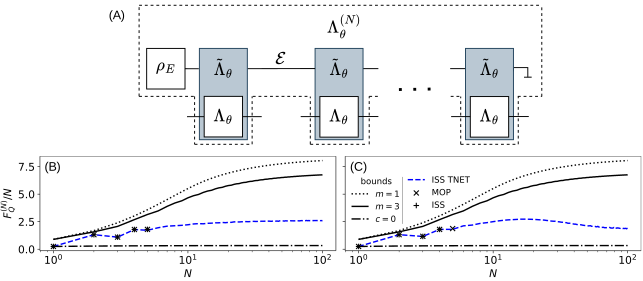
Fig. 10 (A) Diagram of \(N\) parametrized channels \(\Lambda_\theta\) with noise correlations. Extended channels \(\tilde\Lambda_\theta\) (gray) act on the system as \(\Lambda_\theta\) and are connected with each other by the environment space \(\mathcal{E}\). The environment system \(\mathcal{E}\) starts in the state \(\rho_E\) and is not accessed (is traced out) at the end. Values of QFI normalized by the number of channel uses, \(N\), for anti-correlated (\(c=-0.75\)) dephasing (\(p=0.75\)), different strategies: (B) parallel, (C) adaptive and various methods: MOP - black \(\times\), simple ISS with \(d_\mathcal{A}=2\) - black +, tensor network ISS with \(d_\mathcal{A}=2\) (parallel: \(r_\mathrm{MPS}=\sqrt{r_\mathfrak{L}}=2\)) - blue dashed line, upper bound with block size \(m=1\) - black dotted line, upper bound with block size \(m=3\) - black solid line and upper bound for uncorrelated channels \(c=0\) - black dash-dotted line. Notice that since there are no separate bounds for parallel strategy with correlated channels the upper bounds (black dotted and solid lines) are identical in (B) and (C).
The QMetro++ also provides a simple way to compute the QFI for the adaptive and the parallel strategies in scenarios when parameter- encoding channels act on an additional environment space \(\mathcal{E}\) which directly connects subsequent channels, see Fig. 10 (A). This approach allows in particular to model noise correlations affecting the sensing channels.
To illustrate this, let us consider a Kraus representation for the dephasing model with Kraus operators \(K_\pm\) acting as Bloch-sphere rotations by \(\pm\epsilon\) around \(z\) axis, see (17). We want the signs of these rotations to form a binary Markovian chain. The conditional probability of a rotation with sign \(s_i\in\{+,-\}\) in channel \(i\) given \(s_{i-1}\) in channel \(i-1\) is:
where \(c\in[-1, 1]\) is a correlation parameter with \(c=0\) meaning no correlations, \(c=1\) maximal positive correlations and \(c=-1\) maximal negative correlations. The initial probabilities are \(p(\pm)=1/2\).

Fig. 11 Modeling of correlated dephasing process, by extending the action of the channel on a two-dimensional environment space.
This process can be modeled with the help of a two-dimensional environment Hilbert space \(\mathcal{E}\) which will carry the information about the sign of the rotation in the preceding step.
Let us introduce a new channel acting on both the environment and the system \(\tilde\Lambda_\theta = \Phi_\theta * \mathrm{T}\), see Fig. 11, where:
and
Clearly, \(\tilde\Lambda_\theta\) acts as \(\Lambda_\theta\) on the system — \(\mathrm{Tr}_{\mathcal{E}}\tilde\Lambda_\theta(\rho)=\Lambda_\theta(\mathrm{Tr}_{\mathcal{E}}\rho)\) for any state \(\rho\). The unitary channel \(\Phi_\theta\) acts with \(K_\pm\) on the system, depending on the state of the environment being \(\ket{\pm}\), and it stores the information about the occurrence of \(K_\pm\) in the state \(\ket{\pm}\) accordingly. Then \(\mathrm{T}\) modifies the state of \(\mathcal{E}\) according to probabilities (19). The initial probabilities are encoded in the initial environment state \(\rho_E=\mathbb{1}_2/2\).
Channel \(\tilde\Lambda_\theta\) can be easily constructed using the
link_env
method which links two channels through their common environment:
from numpy import array, kron, sqrt
from qmetro import par_dephasing, ket_bra, ParamChannel

p = 0.75
c = -0.75

Lambda = par_dephasing(p, rot_like=True)
krauses, dkrauses = Lambda.dkrauses()
Kp, Km = krauses
dKp, dKm = dkrauses

plus = array([1, 1]) / sqrt(2)
minus = array([1, -1]) / sqrt(2)

V = kron(ket_bra(plus, plus), Kp)
V = V + kron(ket_bra(minus, minus), Km)
V = sqrt(2) * V

dV = kron(ket_bra(plus, plus), dKp)
dV += kron(ket_bra(minus, minus), dKm)
dV = sqrt(2) * dV

Phi = ParamChannel(krauses=[V], dkrauses=[dV], env_dim=2)

T_krauses = []
for s in (1, -1):
    for r in (1, -1):
        x = sqrt((1+s*r*c)/2)
        Tsr = x * ket_bra(array([1, s]), array([1, r]))/2
        T_krauses.append(Tsr)

T = ParamChannel(krauses=T_krauses, env_dim=2)

Lambda_tilde = Phi.link_env(T)
Lambda_tilde = Phi * T
When provided with env_dim argument, the constructor of
ParamChannel
will assume that the channel acts on a space
\(\mathcal{E} \otimes \mathcal{S}\) with \(\dim\mathcal{E}\)
given by the argument. All functions implementing MOP and ISS algorithms
from Parallel strategy optimization and Adaptive strategy optimization can take such a channel
as their argument and optimize the corresponding QFI for a sequence of
channels as in Fig. 10 (A):
...

from numpy import identity
from qmetro import iss_tnet_adaptive_qfi

N = 3
d_a = 2
qfi, *_ = iss_tnet_adaptive_qfi(Lambda_tilde, N, d_a)

rhoE = identity(2) / 2
qfi, *_ = iss_tnet_adaptive_qfi(Lambda_tilde, N, d_a, env_inp_state=rhoE)
Bounds in this case can be computed using
ad_bounds_correlated
and
ad_asym_bound_correlated.
In contrast to the bounds for the
uncorrelated case these bounds are not necessarily tight asymptotically.
They are computed by upper-bounding QFI for adaptive strategy where every
\(m\)-th control operation has access to the environment, for some
integer \(m\). This leads to a leakage of information from the
environment, which weakens the tightness of the bound.
Naturally, larger value of \(m\) makes the bound tighter but at the same time it exponentially increases the execution time. Realistically, one can compute the bound for \(m \lesssim 5\) in case of qubit channels. An exemplary code to compute the bound is given below:
...

from qmetro import ad_bounds_correlated

N = 10
m = 3
ns, bound = ad_bounds_correlated(Lambda_tilde, N, m)
where ns = [1, 1+m, 1+2m, ...], bound = [b_1, b_{1+m}, b_{1+2m}, ...]
and b_n is an upper bound on
\(F_{Q}^{(n)}(\Lambda_\theta)\).
Note that the construction (20), (21) is not unique and correlations (19) can be modeled using different \(\tilde\Lambda_\theta\). For example a quantum channel:
satisfies \(\mathrm{t}\circ \mathrm{t}=\mathrm{T}\) thus \(\tilde\Lambda_\theta = \mathrm{t}*\Phi_\theta*\mathrm{t}\) will give the same \(\Lambda^{(N)}_\theta=\tilde\Lambda_\theta * ... * \tilde\Lambda_\theta\) as before. This observation is important for calculation of upper-bounds because of the aforementioned fact that they are not computed for the whole \(\tilde\Lambda_\theta^{(N)}\) but for \(N/m\) blocks of size \(m\) and the construction influences how these blocks begin and end. For example, it turns out that the original construction (21) gives in this case an unrealistic HS and the optimal bound is achieved for (22), see [45] for more discussion.
Values of the QFI for anti-correlated (\(c=-0.75\)) dephasing case are shown in Fig. 10 (B) and (C). Note, that the presence of (anti)correlations significantly increases the obtained QFI which becomes even larger then the upper-bounds for uncorrelated case. Interestingly, we can see that the adaptive strategy with \(d_\mathcal{A}=2\) is optimal for \(N\le 5\), unlike in the uncorrelated dephasing case, see Fig. 9 (B).