Adaptive strategy optimization
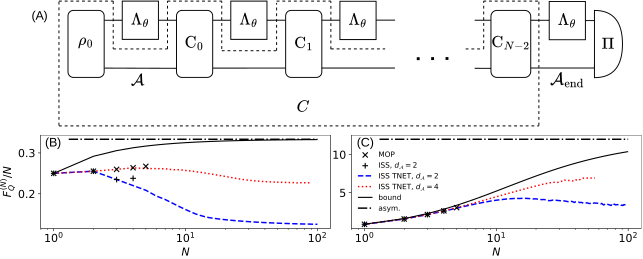
Fig. 9 (A) Diagram of an adaptive strategy with multiple parametrized channels \(\Lambda_\theta\) and ancilla \(\mathcal{A}\). When the optimization is performed over all quantum combs \(C\) (area bounded by dashed lines) one can control the dimension of only the final ancilla \(\mathcal{A}_\mathrm{end}\). Values of QFI normalized by the number of channel uses, \(N\), for: (B) dephasing (\(p=0.75\)) (C) amplitude damping (\(p=0.75\)) and different methods: MOP – black ×, simple ISS with \(d_\mathcal{A}=2\) – black +, tensor network ISS with \(d_\mathcal{A}=2\) – blue dashed line, tensor network ISS with \(d_\mathcal{A}=4\) – red dotted line, upper bound – black solid line, asymptotic bound – black dash-dotted line. Lack of data for \(d_\mathcal{A}=4\), \(N \ge 90\) (B) and \(N \ge 60\) (C) is due to increasing numerical instability of ISS with growing \(N\).
In the adaptive strategy, we start with an initial state of the system and the ancilla, \(\rho_0\), and we act on the system with \(N\) parameter-encoding channels \(\Lambda_\theta\), intertwined with control operations \(\mathrm{C}_i\) which act both on the system and the ancilla, see Fig. 9 (A). Equivalently, it is a strategy where \(N\) parameter-encoding channels \(\Lambda_\theta\) are plugged in between the teeth of a quantum comb \(C\), see Fig. 3, and then the resulting state is measured. In this strategy, one seeks to determine the value of QFI for the optimal input state, measurement, and control operations (or equivalently the optimal comb and measurement). Notice that for sufficiently large ancilla dimension \(d_\mathcal{A}\) and for \(\mathrm{C}_i\) being appropriate SWAP gates one can simulate any parallel strategy with an adaptive strategy. Thus, assuming the ancilla is large enough, the QFI for the adaptive strategy always upper-bounds the QFI for the parallel strategy.
QFI for the adaptive strategy using the MOP method can be computed by
invoking
mop_adaptive_qfi:
from qmetro import *

p = 0.75
channel = par_dephasing(p)

N = 3

qfi = mop_adaptive_qfi(channel, N)
This yields the truly optimal QFI corresponding to the optimal adaptive strategy.
Alternatively, we may also use the ISS method, with the help of
iss_adaptive_qfi.
This procedure will perform the optimization over the whole comb as
well. Note that the constraints on a quantum comb (8)
allow for its decomposition into control operations (CPTP maps), but
do not specify the ancilla dimension inside the comb. Therefore, in
this case one can control only the dimension of the last ancilla which
goes outside of the comb, indicated by the symbol
\(\mathcal{A}_\mathrm{end}\) in Fig. 9 (A):
from qmetro import *

p = 0.75
channel = par_dephasing(p)

N = 3
ancilla_dim = 2

qfi, qfis, comb, sld, status = iss_adaptive_qfi(channel, N, ancilla_dim)
Apart from the standard outputs for ISS-type functions,
iss_adaptive_qfi
returns comb which is a CJ matrix of the optimal comb.
Finally, if we want to make use of the tensor-network structure and
perform the optimization over separate control operations, we can use
iss_tnet_adaptive_qfi.
Notice that in this approach we control ancilla dimension at each step
and thus, in general, the obtained QFI will be smaller than the one
obtained with
iss_adaptive_qfi.
The advantage here is that the
optimization will be much more efficient and this is the only way to
reach large \(N\):
from qmetro import *

p = 0.75
channel = par_dephasing(p)

N = 3
ancilla_dim = 2

qfi, qfis, teeth, sld, status = iss_tnet_adaptive_qfi(
    channel, N, ancilla_dim
)

rho0, *Cs = teeth
The returned argument teeth represents the comb’s teeth and is a
list of the form [rho0, C_0, C_1, ..., C_{N-2}].
The upper bound for the adaptive strategy is computed using
ad_bounds:
from qmetro import *

p = 0.75
channel = par_dephasing(p)

N = 3
bound = ad_bounds(channel, N)
Additionally, one can compute the value of the bound in the limit \(N \rightarrow \infty\) which is asymptotically saturable and the same for both the parallel and the adaptive strategy, see Sec. Upper bounds:
from qmetro import *

p = 0.75
channel = par_dephasing(p)

c, k = asym_scaling_qfi(channel)
The returned values should be interpreted as \(c=\lim_{N\rightarrow\infty} F_Q^{(N)}(\Lambda_\theta)/N^k\).
Values of QFI, bounds, and asymptotic QFI for the adaptive strategy are presented in Fig. 9 (B) and (C). In contrast to the parallel strategy, the amplitude damping case (C) shows results much closer to the bound.
Notice that there is no data for amplitude damping and ancilla dim \(d_\mathcal{A}=4\) and \(N \ge 60\). This is due to the fact that for this noise model, the QFI attains a large value and simultaneously optimal control operations \(\mathrm{C}_i\) take the state close to the pure state. These two processes combined create objects (tensors, matrices etc.) which hold values from a very wide range at the same time. This causes loss of precision and then numerical instability. A similar issue appears for dephasing but for much larger \(N\simeq90\).