Parallel strategy optimization
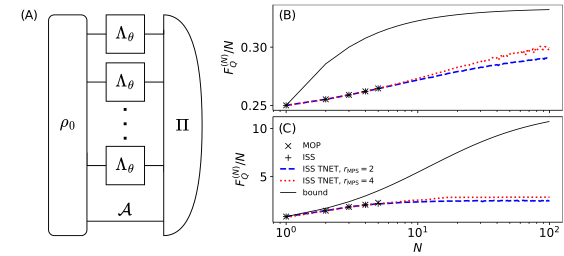
Fig. 8 (A) Diagram of a parallel strategy with multiple parametrized channels \(\Lambda_\theta\) and ancilla \(\mathcal{A}\). Values of QFI normalized by the number of channel uses, \(N\), for: (B) dephasing (\(p=0.75\)), (C) amplitude damping (\(p=0.75\)) and different methods: MOP – black ×, simple ISS with \(d_\mathcal{A}=2\) – black +, tensor network ISS with \(d_\mathcal{A}=2, \; r_\mathrm{MPS}=\sqrt{r_\mathfrak{L}}=2\) – blue dashed line, tensor network ISS with \(d_\mathcal{A}=2, \; r_\mathrm{MPS}=\sqrt{r_\mathfrak{L}}=4\) – red dotted line, upper bound – black solid line.
The parallel strategy refers to a setting in which \(N\) copies of
\(\Lambda_\theta\) are probed in parallel by an entangled state and
their output is collectively measured, see Fig. 8 (A).
It can also be understood as a strategy with a single channel
\(\Lambda_\theta^{(N)}=\Lambda_\theta^{\otimes N}\). The QMetro++
package provides several functions computing the QFI for the parallel
strategy. The simplest two,
iss_parallel_qfi and
mop_parallel_qfi,
are straightforward generalizations of ISS and MOP methods for the
parallel strategy:
from qmetro import *

p = 0.75
channel = par_dephasing(p)

N = 3
ancilla_dim = 2
iss_qfi, qfis, rho0, sld, status = iss_parallel_qfi(channel, N, ancilla_dim)

mop_qfi = mop_parallel_qfi(channel, N)
The downside of these two approaches is that they try to optimize QFI over all possible states and measurements on an exponentially large Hilbert space. Hence, their time and memory complexity are exponential in the number of channel uses. In practice, this means that they can be used for relatively small \(N\) (\(N \lesssim 5\) in case of qubit channels).
This problem can be circumvented using tensor networks MPS
Fig. 4 and MPO Fig. 5.
This approach is implemented in
iss_tnet_parallel_qfi,
which requires two additional arguments specifying bond dimensions of
the MPS and the pre-SLD MPO:
from qmetro import *

p = 0.75
channel = par_dephasing(p)

N = 3
ancilla_dim = 2
mps_bond_dim = 2
L_bond_dim = 4

qfi, qfis, psis, Ls, status = iss_tnet_parallel_qfi(
    channel, N, ancilla_dim, mps_bond_dim, L_bond_dim
)
In contrast to the function implementing the basic ISS, which returns
the optimal input state and the SLD in terms of arrays, this procedure
gives them in the form of lists containing tensor components:
psis = [psi_0, psi_1, ...] and Ls = [L_0, L_1, ...], see
Fig. 4 and Fig. 5.
Naturally, increasing ancilla and bond dimensions allows one to achieve
higher values of QFI up to some optimal value, see
Fig. 8 (B) and Fig. 8 (C). One might
assess this value by running
iss_tnet_parallel_qfi
for progressively larger dimension sizes, but it can also be
upper-bounded using the
par_bounds function which
gives a bound on the QFI of the parallel strategy for all ancilla and
bond dimension sizes (see Sec. Upper bounds):
from qmetro import *

p = 0.75
channel = par_dephasing(p)

N = 3

bound = par_bounds(channel, N)
The obtained value is an array bound = [b_1, b_2, ..., b_N] where
b_n is an upper bound on
\(F_Q^{(n)}(\Lambda_\theta)\).
The numerical results are presented in Fig. 8 (B) and (C). We considered the parallel strategy with ancilla dimension \(d_\mathcal{A}\) and various bond dimensions \(r_\mathrm{MPS}=\sqrt{r_\mathfrak{L}}\). The relation between \(r_{\mathrm{MPS}}\) and \(r_{\mathfrak{L}}\) was chosen based on the fact that the density matrix of the input state has bond dimension equal to \(r_\mathrm{MPS}^2\), so taking \(r_\mathfrak{L}\) up to this value should not significantly affect the execution time (in practice, a smaller \(r_\mathfrak{L}\) is typically sufficient). Notice that for the dephasing case (B) results from MOP and ISS methods coincide perfectly and that QFI for MPS with \(r_\mathrm{MPS}=4\) approaches the upper bound as \(N\) increases. This suggests that in this case \(d_\mathcal{A}=2\) is sufficient to saturate the bound. On the other hand, for the amplitude damping case (C) the results obtained using MOP and ISS differ, and already for \(N=5\) the ancilla dimension \(d_\mathcal{A}=2\) is suboptimal. Additionally, \(F_Q^{(N)}(\Lambda_\theta)/N\) computed using MPS quickly flattens out and the increase of bond dimension leads to a very small improvement. Therefore, we can conclude that in this case the dimensions \(d_\mathcal{A}\) considered are insufficient to saturate the bound.