Theoretical background
Quantum metrology [1, 2, 3, 4] is now rightfully regarded as one of the main pillars of the rapidly developing field of quantum technologies [5]. It focuses on the ways to exploit delicate quantum features of light and matter to enhance the sensitivity of practical measuring devices. Apart from numerous experimental breakthroughs in the field, including the use of squeezed states of light in gravitational wave detectors [6, 7], quantum-enhanced magnetometry [8], gravitometry [9], atomic clocks [10] and many others, the field has also enjoyed significant theoretical progress with numerous analytical and numerical methods being developed that help to design better metrological protocols as well as understand the fundamental limitations of quantum-enhanced protocols in the presence of decoherence [11, 12, 13, 14, 15, 16, 17, 18, 19, 20, 21, 22, 23].
The purpose of this package is to make these advanced and powerful numerical methods accessible to the community. We realize that despite the fact that the core elements of the methods have been discussed in the literature already for a couple of years, they are still not widely used in the field due to their somewhat steep ‘initial learning curve’ and the fact that there is no single publication that provides a unified presentation of all of them, not to mention a numerical package. Moreover, we significantly expand the applicability of the latest tensor network-based methods to include general protocol structures, which allows for dealing with e.g. collisional metrological schemes.
This package adopts the frequentist approach to quantum metrology and focuses on quantum Fisher information (QFI) as the figure-of-merit to be optimized [24, 25, 26]. At this point, we do not include quantum Bayesian methods in the package, even though some of the optimization procedures discussed here have their Bayesian counterparts, and may be added in the future updates.
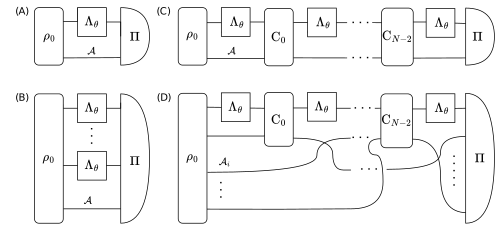
Fig. 1 Different classes of metrological strategies that one can optimize using the package: (A) optimization of a single channel input probe \(\rho_0\) (potentially entangled with an ancillary system \(\mathcal{A}\)), (B) optimization of an entangled state \(\rho_0\) of \(N\) input probes in a parallel strategy (potentially additionally entangled with an ancillary system \(\mathcal{A}\)), (C) optimization of an input probe \(\rho_0\) and control operations \(C_i\) in an adaptive metrological scheme, (D) a customized protocol structure, here inspired by quantum collisional models, where multi-partite entangled ancillary state is sent piece-by-piece to interact with a common sensing system via interaction gates \(C_i\). Here the optimization may affect either the input state \(\rho_0\) or interaction gates \(C_i\) or both. The above strategies correspond to functions listed in Table 1.
strategy |
\(N\) regime |
package functions |
section |
|---|---|---|---|
|
1 |
||
|
small |
||
|
large |
||
|
large |
||
|
small |
||
|
large |
||
|
large |
||
|
large |
||
|
large |
|
Advanced package usage—optimization of strategies with arbitrary structures |
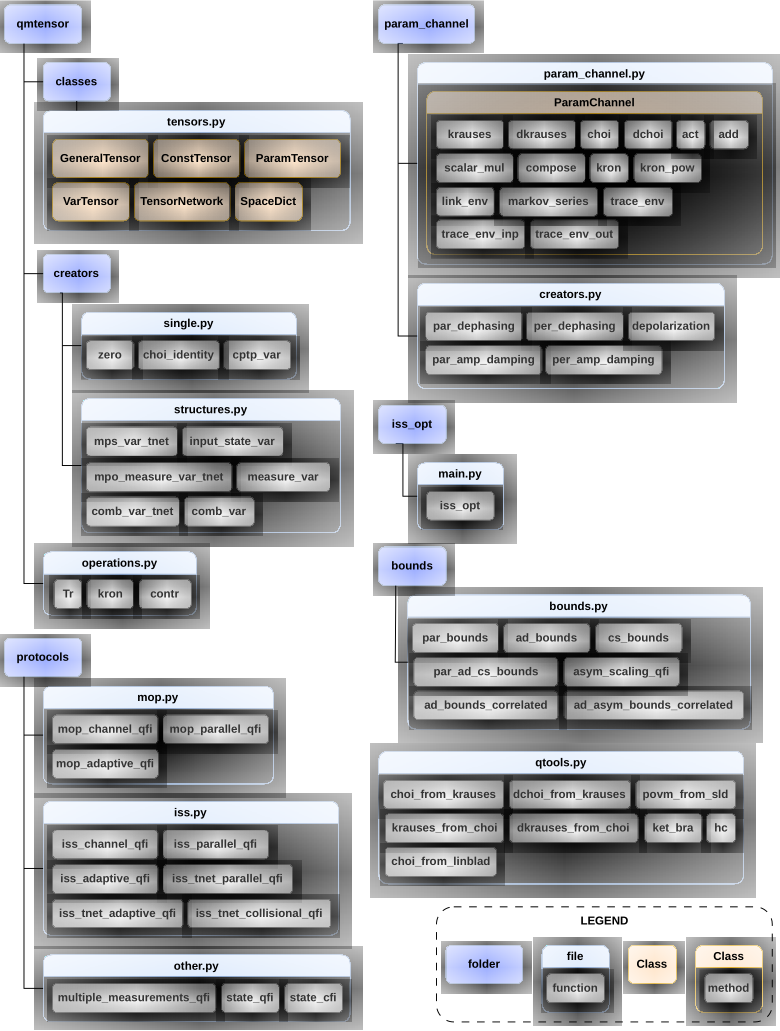
Fig. 2 File structure of the package with a selection of the most important functions. Classes from classes/tensors file are displayed in more detail in Fig. 13. All functions, classes and methods are listed and described in the package documentation [27].