Iterative see-saw
In the ISS optimization method developed in the context of quantum metrology [17, 22, 38, 39, 40, 41, 42] one considers the pre-QFI function:
where \(\rho_\theta = \Lambda_\theta \otimes \mathbb{I}_\mathcal{A} (\rho_0)\), and the dimension of \(\mathcal{A}\) can be chosen arbitrarily and this choice may affect the final result, unlike in the MOP method. It turns out that for a given \(\rho_0\) the maximization of \(F\) over Hermitian matrices \(\mathfrak{L}\) yields the QFI of the state \(\rho_\theta\):
with the solution \(\mathfrak{L}^\diamond\) equal to the SLD matrix \(L\) of \(\rho_\theta\) [39]—hence we will refer to \(\mathfrak{L}\) as the pre-SLD matrix for \(\mathfrak{L}\). It follows that the channel QFI (4) is simply a maximization of \(F\) over both of its arguments:
This problem can be solved by initializing \(\rho_0\) and
\(\mathfrak{L}\) at random and then by alternately making one
argument constant and maximizing the other one. Each such optimization
will increase the value of \(F\) and we can proceed until the change
of \(F\) in a number of consecutive iterations becomes smaller than
some established precision \(\epsilon\). In case of the
single-channel optimization the procedure is implemented in
iss_channel_qfi.
ISS algorithm can be easily applied to the parallel strategy by simply
substituting \(\Lambda_\theta\) with
\(\Lambda^{(N)}_\theta = \Lambda^{\otimes N}_\theta\)—this is
implemented in iss_parallel_qfi function. This approach,
however, suffers from the same problem as MOP—namely, it has an
exponential complexity in \(N\).
The solution is to split \(\rho_0\) and \(\mathfrak{L}\) into smaller parts by expressing them as tensor networks (see Appendix Tensor network formalism and tensor representation). Let us set \(\mathcal{I}^{(N)} = \bigotimes_{i=0}^N\mathcal{I}_i\) and \(\mathcal{O}^{(N)} = \bigotimes_{i=0}^N\mathcal{O}_i\), where for \(i< N\) spaces \(\mathcal{I}_i\) and \(\mathcal{O}_i\) are inputs and outputs of the \(i\)-th channel \(\Lambda_{\theta, i}\) and \(\mathcal{I}_N=\mathcal{O}_N=\mathcal{A}\). Then a state
can be expressed as a tensor network called a matrix product state (MPS) [43, 44]:
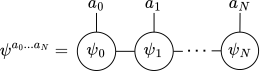
Fig. 4 Matrix product state.
where indices \(a_i\) are called physical indices and horizontal indices that connect tensors \(\psi_i\) are called bond indices. Range of the bond indices, called the bond dimension and denoted by \(r_\mathrm{MPS}\), controls the strength of possible correlations between sites of \(\ket{\psi}\), \(r_\mathrm{MPS}=1\) means that the state is separable and \(r_\mathrm{MPS}\approx\dim\mathcal{I}^{(N)}\) allows for arbitrary correlations. Analogously, pre-SLD matrix can be expressed as a matrix product operator (MPO):

Fig. 5 Matrix product operator of \(\mathfrak{L}\).
with bond dimension \(r_\mathfrak{L}\). We can then write the pre-QFI function as
where \(\rho_0^i\) are elements of the density matrix MPO of the state \(\ket{\psi}\):
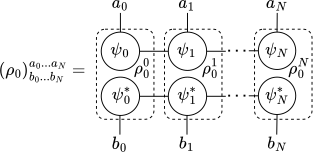
Fig. 6 Density matrix MPO of the MPS state.
\(\psi_i^*\) are entry-wise complex conjugations of \(\psi_i\) and \(\mathfrak{L}_i^2\) are elements of MPO of \(\mathfrak{L}^2\). Additionally, we used linearity of link product and the identity \(\mathrm{Tr}(AB) = A*B^T\). Note that \(\ast\) denotes link product operation, but also contraction of corresponding spaces for more general tensor networks, e.g. MPSs, see Appendix Tensor network formalism and tensor representation for more details.
Just like in the case of a single channel optimization, we can maximize
the above function over one argument at a time while others stay
constant. Then after optimization of each argument, we repeat the
procedure until the value of \(F\) converges. Note that if
\(r_\mathfrak{L}\) is too small, then the optimization over pre-SLD
will not converge to the SLD matrix and value of pre-QFI will not be
equal to QFI. Nevertheless, the obtained value of \(F\) can always
be interpreted as a CFI for a measurement given by eigenvectors of
\(\mathfrak{L}\) [39]. The procedure employing
MPS and MPO to the optimization of parallel strategy is implemented in
iss_tnet_parallel_qfi.
For the adaptive strategy we can apply the formula on \(\rho_\theta\) from Fig. 3 to (10) and redefine pre-QFI function as
Then, the QFI for adaptive strategy becomes a maximization of
(11) over Hermitian \(\mathfrak{L}\) and quantum
combs (8)—this is implemented in
iss_adaptive_qfi. Once more, this problem can be
solved more efficiently if we split arguments of \(F\) into smaller
parts. This time, however, the tensor network of \(\textrm{C}\) has
a natural interpretation as an input state \(\rho_0\) and a series
of control operations \(\mathrm{C}_i\) like in
Fig. 1 (C). Thus we can optimize
We implemented this procedure in
iss_tnet_adaptive_qfi.
Finally, ISS can be applied to any arrangement of input states, control
operations and parametrized channels, see the example in
Fig. 1 (D). This is done by expressing
\(\rho_\theta\) as the contraction of tensors representing all
channels, measurements (possibly represented by MPOs) and states
(possibly represented by MPSs) and maximizing pre-QFI over each
variable node separately. The package provides tools to define such
arbitrary protocols which can be then optimized using
iss_opt function. We discuss
this in detail in Sec. Advanced package usage—optimization of strategies with arbitrary structures.
Let us conclude this section with a comparison of MOP and ISS. MOP is a deterministic algorithm with optimality of the numerical solution guaranteed by formal proofs. ISS initializes the parameters of pre-QFI function at random, thus it is nondeterministic. Additionally, there is no guarantee that it converges to the true optimum of the pre-QFI function. The optimality can be validated in some cases by comparing its result with MOP or upper bounds, see Sec. Upper bounds. It might be also useful to repeat the computation several times and check whether the returned values vary.
On a positive side, what is guaranteed in ISS is that the figure of merit will not decrease at any individual iteration step and that the final result will always be a correct lower bound of a truly optimal QFI.
Moreover, ISS is much more efficient than MOP. Its exact time complexity depends on the strategy and it is hard to estimate. Our numerical data shows that for strategies that are similar to parallel or adaptive strategy and with the use of tensor networks the time complexity is quadratic in \(N\). This is significantly better than exponential complexity of MOP and allows to compute QFI for significantly larger values of \(N\) (\(N\le5\) for MOP vs \(N\le 100\) for ISS). Moreover, in ISS we can control additional parameters like ancilla or bond dimension and consider strategies different from parallel and adaptive. Finally, while both methods can be used to get the optimal adaptive or parallel protocols, it is much more straightforward for ISS, as it requires only inspecting the final values of the pre-QFI function optimized arguments.