Tensor network formalism and tensor representation
It is convenient to denote tensors and their contractions using diagrams. In this formalism tensor \(T^{\mu_0\mu_1\ldots\mu_{n-1}}\) is represented as a vertex of a graph with an edge for each index:
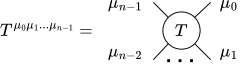
and contraction of indices is depicted as a connection of these edges:

Tensor network formalism can be used to conveniently express the link product. For a Hilbert space \(\mathcal{H}=\bigotimes_{i=0}^{n-1}\mathcal{H}_i\) with \(d_i:=\dim \mathcal{H}_i\) and a linear operator acting on it:
we define the tensor representation of \(M\) to be a tensor:
Next, consider channels \(\mathrm{P}\), \(\mathrm{Q}\) and \(\mathrm{R} = \mathrm{P} * \mathrm{Q}\) from (26) and Fig. 15. One can easily check that tensor representations of their CJ matrices satisfy:

which mirrors the circuit diagram from Fig. 15. Due to the similarity of these two diagrams, in the main text we drop the symbol \(\sim\) and we depict strategies using circuit diagrams and tensor network diagrams interchangeably.
When \(M\) is an MPO:
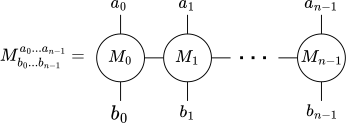
we can extend this definition to its components \(M_i\) such that \(\tilde{M}\) will be a result of contraction of tensors \(\tilde{M}_i\):
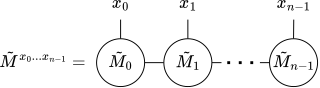
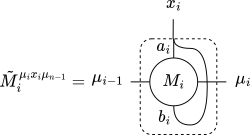
that is, only physical indices of \(M_i\) are joined. This, combined with the
use of * to denote both link product and tensor contraction, allows for
convenient depiction of link product with CJ matrices which are MPOs.